 blog
blog
Best Natural Soap for Sensitive Skin: A 2026 Guide
Table of Contents
- Why Natural Soap Works Better for Sensitive Skin
- Ingredients to Avoid in Soap for Sensitive Skin
- How to Choose Natural Soap for Sensitive Skin
- Benefits of Goat Milk Soap for Skin
- pH Balance, Hard Water, and Other Factors That Affect Sensitive Skin
- What to Look for in a Natural Soap Bar
- Frequently Asked Questions
Last Updated: September 21, 2026
Why Natural Soap Works Better for Sensitive Skin
The best natural soap for sensitive skin is one built around a short, recognizable ingredient list, a skin-friendly pH, and no added fragrance. That combination matters more than any single "miracle" oil, because sensitive skin reacts to what a bar leaves behind long after you rinse.
The Skin Barrier and Why It Matters
Your skin barrier is the outer layer that locks in moisture and keeps irritants out. When it's intact, soap rinses cleanly and skin feels comfortable; when it's compromised, even mild ingredients sting.
Ingredients to Avoid in Soap for Sensitive Skin
The ingredients to avoid in soap for sensitive skin are synthetic fragrance, sulfates, parabens, and harsh surfactants like sodium lauryl sulfate. These are the usual suspects behind redness, inflammation, and flare-ups.
Here's what to scan for on a label:
- "Fragrance" or "parfum", an umbrella term that can hide dozens of undisclosed compounds
- Sodium lauryl sulfate (SLS) and sodium laureth sulfate (SLES), cheap surfactants that produce big lather and big irritation
- Parabens (methyl, propyl, butyl), preservatives some people react to
- Synthetic dyes like FD&C colors, purely cosmetic, no benefit to skin
- Triclosan, an antibacterial agent linked to irritation and hormone concerns
Fragrance, Sulfates, and Other Common Triggers
Fragrance is the single biggest offender for reactive skin: a bar can smell wonderful and still cause a rash, because "fragrance" on a label doesn't reveal which of hundreds of possible compounds is inside.
How to Choose Natural Soap for Sensitive Skin
To choose natural soap for sensitive skin, match the bar to your specific trigger, patch test before committing, and prioritize a short ingredient list. Five ingredients you can pronounce beat twenty you can't, but why one natural oil soothes where another inflames comes down to fatty-acid structure.
Match the Oil to the Condition, Not Just the Label
Not all "natural" oils behave the same on reactive skin. A dermatologist-led way to read a bar is to look at the first oil listed and ask what its fatty-acid profile does to the barrier:
- Jojoba oil is technically a liquid wax ester, not a triglyceride, so its structure closely mimics human sebum. That makes it one of the least likely plant ingredients to clog pores or provoke a reaction, which is why it shows up in formulas built for rosacea-prone and acne-prone skin.
- Coconut oil lathers beautifully and cleanses hard, but its high lauric-acid content makes it more comedogenic and more likely to leave a stripping, tight feeling on dry or eczema-prone skin. A bar with coconut oil as the first ingredient is usually better suited to oily skin than reactive skin.
- Olive oil (the base of traditional Castile soap) is high in oleic acid, emollient but heavy, and slow to absorb for some compromised barriers. Gentle, but not always ideal during active flare-ups.
- Shea and cocoa butters are high in stearic and oleic acids and act as occlusives, slowing water loss rather than drawing water in. Useful for dryness, but not a substitute for a humectant like glycerin.
- Oatmeal and colloidal oat contain avenanthramides, studied for calming itch and redness. A bar listing colloidal oatmeal near the top does more for a flare-up than one that simply avoids fragrance.
Ask These Questions Before You Buy
- What sets off your skin? If it's fragrance, go fragrance-free. If it's dryness, prioritize emollient butters like shea or cocoa, paired with a humectant, or you're only sealing in dryness.
- What's your skin type? Oily skin tolerates more cleansing power and can handle coconut-forward bars. Dry, eczema-prone, or rosacea-prone skin does better with jojoba, olive, or goat-milk bases and lower cleansing power.
- Is the bar cold-processed? Cold-processed soaps retain more natural glycerin, the humectant that pulls water into skin, barrier work a detergent bar cannot do.
- What's the pH? True soap sits around 9 to 10, which is alkaline. That's normal, but pH-balanced syndet bars may suit very reactive skin better. See the pH section below for the full mechanism.
- Is it labeled fragrance-free or unscented? They are not the same. Unscented bars can still contain masking fragrance.
Reading Labels and Patch Testing at Home
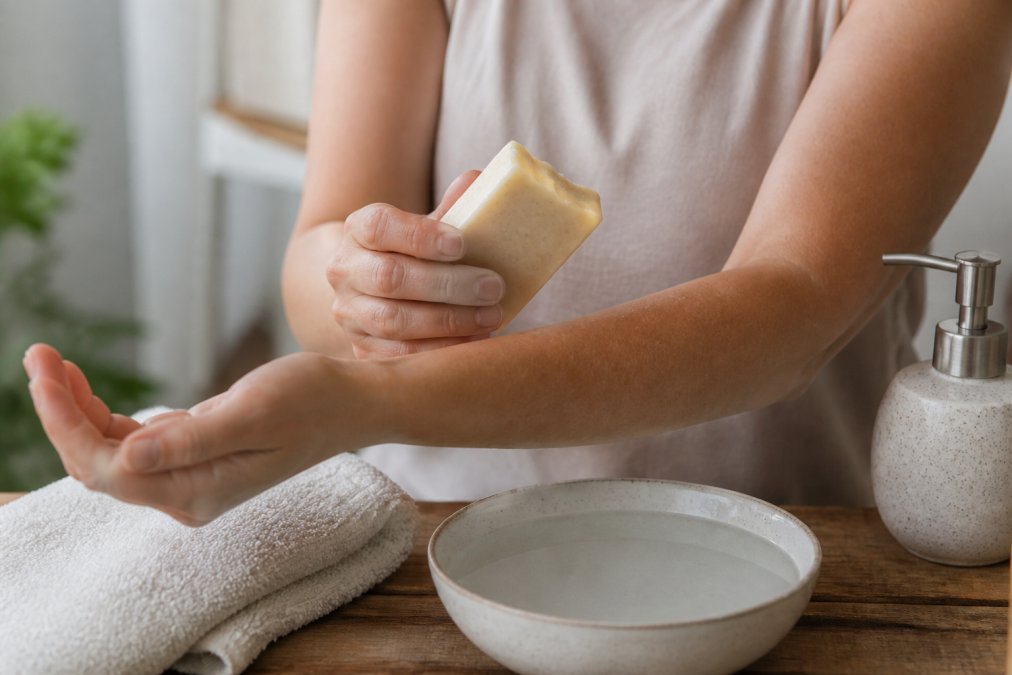
A patch test is the only reliable way to know how your skin will respond to a new bar. It takes 48 hours and costs nothing.
- Wash a small area on your inner forearm with the soap.
- Pat dry and leave it uncovered.
- Wait 24 hours and check for redness, itching, or bumps.
- If clear, repeat on the same spot and check again at 48 hours.
- Only then use the bar on your face or full body.
Benefits of Goat Milk Soap for Skin
Goat milk soap is prized for sensitive skin because its fatty acids, lactic acid, and natural emollients soften and nourish without stripping. The fats closely resemble those in human skin, which is why it feels gentler than many plant-oil-only bars.
Here's what goat milk brings to a bar:
- Lactic acid, a mild exfoliant that helps smooth rough, dryness-prone patches
- Fatty acids, support the skin barrier and lock in moisturizing benefits
- Vitamin A, an antioxidant that supports skin renewal
- Creamy lather, a rich, low-irritation lather that doesn't rely on sulfates
pH Balance, Hard Water, and Other Factors That Affect Sensitive Skin
Two factors trip up sensitive skin more than any ingredient list: pH balance and hard water. Most people never consider either, then wonder why a "gentle" bar still leaves their skin tight.
The Acid Mantle, Explained
Healthy skin sits at a pH of about 4.5 to 5.5, slightly acidic. That acidity is the acid mantle, a thin film of sebum and sweat that keeps lipid-breaking enzymes switched off, limits harmful bacteria, and supports the ceramides holding the barrier together.
Hard Water: The Hidden Variable
Hard water contains dissolved calcium and magnesium. When those minerals meet soap, they form soap scum, an insoluble film of calcium and magnesium stearate that clings to skin and blocks pores, while preventing proper lather so you use more soap and rinse longer.
What to do about it:
- A shower filter targeting calcium and magnesium (not just chlorine) reduces the mineral load before it reaches your soap. Look for filters rated for hardness, not just sediment.
- A pH-balanced syndet bar sidesteps the problem entirely, because syndets don't react with calcium and magnesium the way true soap does. They rinse clean in hard water.
- A chelating ingredient like citric acid or sodium citrate in the bar's formula can bind minerals and reduce scum. If a natural bar lists one of these, it was likely formulated with hard water in mind.
- Rinsing with filtered or softened water as a final step removes the film before it dries.
Other Factors Worth Knowing
- Water temperature. Hot water strips lipids faster than warm. During a flare-up, turning the temperature down does more than switching products.
- Wash frequency. Twice a day is plenty for most people. Over-washing, even with a gentle bar, depletes the barrier faster than it can rebuild.
- Time on skin. Lather, rinse within about 30 seconds, and pat dry. Leaving soap on longer doesn't clean better; it just gives alkaline residue more time to disrupt the mantle.
- What you apply after. Soap removes some lipids no matter how gentle. A fragrance-free moisturizer applied within minutes of patting dry, while skin is still damp, helps the barrier recover faster than soap choice alone.
What to Look for in a Natural Soap Bar
A bar worth buying for sensitive skin hits five marks: a short ingredient list, no synthetic fragrance, real glycerin, skin-friendly oils and butters, and honest labeling. Everything else is marketing.
| What to Look For | Why It Matters | Red Flag |
|---|---|---|
| Short ingredient list | Fewer potential triggers | 20+ ingredients |
| Fragrance-free label | Avoids top irritant | "Fragrance" or "parfum" |
| Glycerin listed | Retains moisture | Glycerin stripped out |
| Shea, cocoa, or goat milk | Emollient and soothing | Only cheap fillers |
| Cold-processed | Preserves natural oils | "Detergent bar" |
| Non-comedogenic oils | Won't clog pores | Coconut oil as first ingredient |
Frequently Asked Questions
What is the healthiest soap to use on your skin?
The healthiest soap for most people is a pH-balanced, fragrance-free bar made with plant-based oils and butters like olive oil, shea butter, or goat milk. These ingredients clean without stripping the skin barrier. Avoid bars listing synthetic fragrance, sodium lauryl sulfate, or parabens near the top of the label. Cold-processed soaps that retain natural glycerin are a strong choice because glycerin helps skin hold moisture after washing.
Which ingredients should be avoided in soap for sensitive skin?
Watch for synthetic fragrance (often listed as 'parfum'), sodium lauryl sulfate (SLS), sodium laureth sulfate (SLES), parabens, and formaldehyde-releasing preservatives. Also skip bars with artificial dyes, triclosan, and high concentrations of essential oils like cinnamon or citrus, which can irritate delicate skin. If you have eczema, choose fragrance-free formulas and look for short ingredient lists you can actually pronounce.
Are natural soaps better for sensitive skin than commercial brands?
Natural soaps can be better because they often skip harsh surfactants and synthetic additives that trigger dryness, itching, or inflammation. Many commercial bars use detergents that strip the skin barrier and leave it tight. That said, 'natural' is not regulated the same way as 'organic,' so a bar can claim natural and still contain essential oils that bother you. Check the full ingredient list and patch test before committing.
How do I patch test a new natural soap?
Wet a small area on your inner forearm, lather the soap, and leave it for 24 hours without rinsing. If you see redness, itching, or bumps, do not use it on your face or body. Repeat on a second spot if the first test is clear. Patch testing is especially important with bars containing essential oils, since reactions can take a day to show up.