 How-to
7 Steps to Choose Artisan Handmade Soap You'll Love
Last Updated: November 2, 2026
Quick Summary
To choose handmade soap, match the bar to your skin type and read the ingredient list from largest amount to smallest. Dry skin often does well with butters and olive oil, while sensitive skin does best with short, fragrance-free formulas. Patch test any new bar for a few days before using it all over.
- Check the first three to five ingredients, since labels list them by weight.
- Dry or tight skin tends to suit shea, cocoa, or mango butter and olive oil.
- Sensitive skin often does best with fragrance-free or lightly scented bars.
- Be cautious of "fragrance" listed without saying what it is.
- Test a new bar for a full week before judging it.
Table of Contents
- Why Artisan Handmade Soap Differs From Commercial Bars
- How to Choose Soap for Your Skin Type
- Best Handmade Soap for Sensitive Skin
- Handmade Soap Ingredients to Look For
- Reading Ingredient Labels and Soap Claims
- Quality Checks Before You Buy
- How to Make Handmade Soap Last Longer
- Choosing Your First Kids' Soap With a Toy Inside
- Frequently Asked Questions
Why Artisan Handmade Soap Differs From Commercial Bars
At FORYOURSOAP.COM, we make small-batch soap by hand, and the difference shows up the moment you use it. Many commercial bars are instead built from synthetic detergents, which is why they can feel stripping on the skin.
Handmade soap is often made with plant oils, so it can feel richer and less harsh. Storage matters for any bar, so keep yours dry between uses.
- Often made in small batches
- Usually made with plant oils
- Commonly sold with ingredient lists you can read
How to Choose Soap for Your Skin Type
Skin type is the fastest filter you can apply, but "dry," "oily," and "sensitive" are not fixed categories, they shift with season, age, humidity, and how often you shower. Use the table below as a starting point, then adjust based on how your skin feels 30 minutes after toweling off. That post-shower window is the most reliable signal you have: tight and itchy points to a bar that is too cleansing, while greasy or filmy points to one that is too heavy.
| Skin pattern | What tends to work | What to watch for |
|---|---|---|
| Dry or tight after washing | Shea butter, cocoa butter, mango butter, olive oil as leading ingredients | High coconut oil as the first oil; strongly scented bars |
| Oily or shiny by midday | Lighter oils, clay (kaolin, bentonite), gentle citrus essential oils | Over-cleansing, which can trigger more oil production |
| Combination (oily T-zone, dry cheeks) | A mild all-over bar plus a separate facial bar | Using one stripping bar on both face and body |
| Reactive or easily flushed | Short ingredient lists, fragrance-free or low-fragrance, oatmeal, calendula | "Fragrance" listed without detail; essential-oil blends |
A few mechanisms are worth knowing. Soap cleans by binding oil and water, so every bar removes some of your skin's natural lipids, the question is how much and how fast the bar gives moisture back. Butters and olive oil leave a heavier emollient film; clay absorbs surface oil but can feel drying if left on too long. That is why a bar that rescues dry winter skin can feel suffocating in summer.
If you have a diagnosed skin condition, treat this section as background and confirm any switch with your dermatologist. For everyone else, the practical move is to buy one bar at a time, note the first three ingredients, and keep a short list of what worked.
Best Handmade Soap for Sensitive Skin
Sensitive skin often does best with a simple formula. Look for fragrance-free or lightly scented bars with a short ingredient list.
Patch test any new bar on the inside of your wrist for a few days before using it all over. If you have a condition like eczema, check with your dermatologist before switching products.
Handmade Soap Ingredients to Look For
A good handmade bar lists its oils clearly, from the largest amount to the smallest. Be cautious of bars that list "fragrance" without saying what it is, since that can hide irritating compounds.
Essential oils add scent, but they can also irritate some people. Our guide to essential oils in soap explains the skin benefits of common oils, from calming lavender to antimicrobial tea tree.
Reading Ingredient Labels and Soap Claims
Many buyers stop at the front of the package. The back is where the real information lives, and a five-minute read will tell you more than any "all natural" badge. Here is a repeatable method.
1. Find the ingredient list, not the marketing panel. Ingredients are listed in descending order by weight, so the first three to five names tell you what the bar is mostly made of. If olive oil or shea butter appears after fragrance and colorants, the bar is not really an olive-oil or shea bar.
2. Learn the common INCI names. Handmade soap labels often use the International Nomenclature of Cosmetic Ingredients, which sounds chemical but is just the standardized name. Sodium olivate is saponified olive oil; sodium cocoate is saponified coconut oil; sodium shea butterate is saponified shea butter; glycerin is the humectant naturally produced during saponification. Seeing these names is normal and does not mean the bar is synthetic.
3. Separate saponified oils from added ingredients. A cold-process bar will list the soap itself (the sodium salts of the oils) plus any superfatting oils, butters, clays, botanicals, and fragrance added after trace. Superfatting, leaving a small percentage of oil unsaponified, is a common technique for making a bar milder, and some makers state the percentage.
4. Treat "fragrance" as a category, not a disclosure. Under U.S. labeling conventions, the single word "fragrance" can stand in for a blend without listing its components. That is legal, but it limits what you can evaluate. If you are fragrance-reactive, look for "fragrance-free," an explicit essential-oil list, or a maker who publishes a full allergen statement.
5. Check what "natural," "pure," and "handmade" actually promise. These terms are not defined for soap the way they are for some foods, so they function as marketing language rather than guarantees of gentleness. "Handmade" usually signals small-batch production; it does not tell you the recipe, the cure time, or the scent load. Ask the maker directly, a transparent one will answer.
6. Look for quality signals beyond the ingredient list. A stated cold-process method, a cure time of four to six weeks, a batch or lot number, and clear photos of the actual bar all suggest a maker who tracks what they produce. None of these proves a bar will suit your skin, but together they separate a documented product from an anonymous one.
If a claim matters to you, palm-free, vegan, sustainably sourced, ask for the substantiation behind it. Makers who can explain their sourcing are usually the same ones whose labels are worth reading.
Quality Checks Before You Buy
Before you order, check the basics. A well-made bar should be firm, evenly colored, and free of a strong chemical smell. Ask whether the soap was cured before you buy.
- Confirm how the bar was made and cured
- Check that the ingredient list is complete
- Look for clear photos of the actual bar
How to Make Handmade Soap Last Longer
Keep bars dry between uses. A soap dish with drainage prevents mush and extends the life of the bar. Storing bars in a breezy spot rather than a sealed shower caddy helps too.
Rotating bars can also stretch your supply.
Choosing Your First Kids' Soap With a Toy Inside
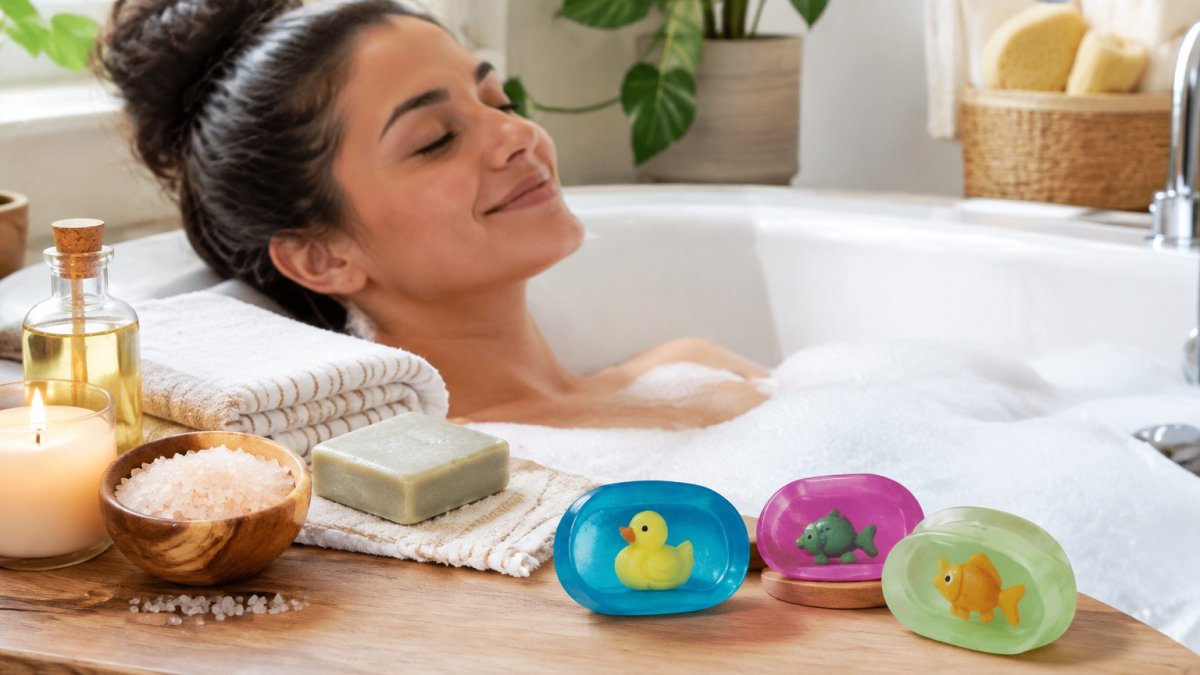
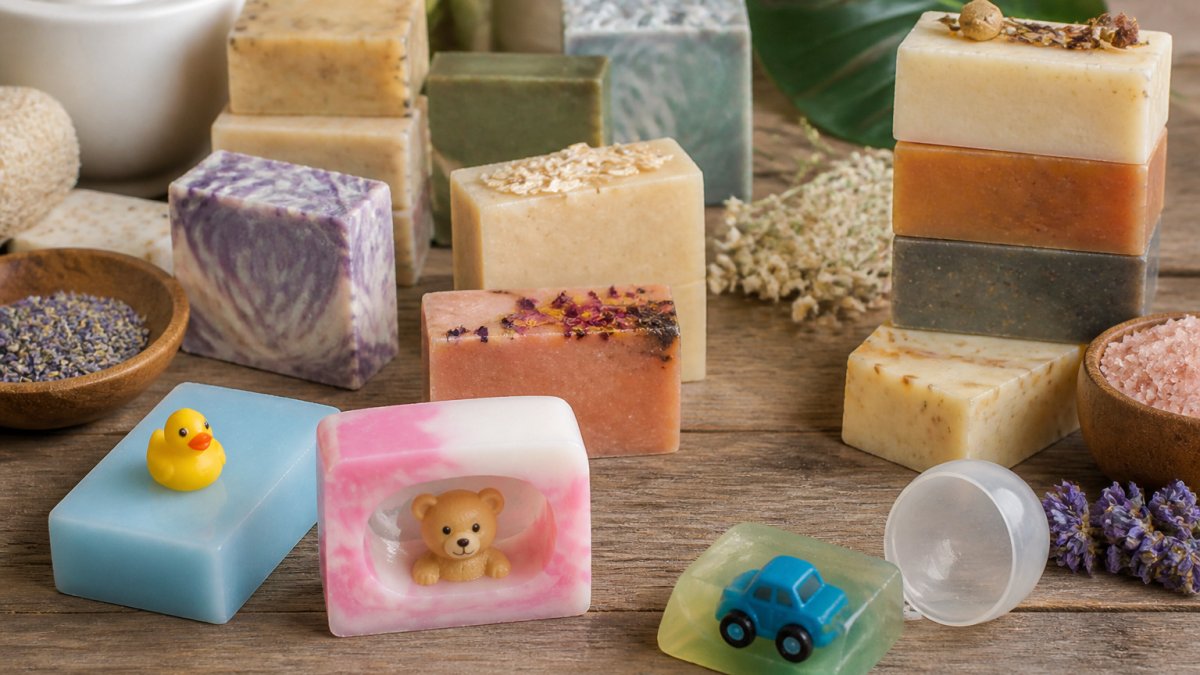
Our kids' soaps with a toy inside are a fun way to get children washing. They are sold as kids novelty soap, surprise toy soap, bath soap with toy, and party favor soap, and many parents buy them for birthdays and bath time. We now have photos of the kids soaps so you can see them before you order, and you can browse the Soap Gift Basket for ideas.
Safety note: The embedded toy is a choking hazard for children under 3 (Small Parts and Choking Hazard Labeling FAQs). Only give these to children old enough to use them safely, and always supervise bath time. Check the age guidance on the product before buying.
Frequently Asked Questions
How do you make artisan soap?
Artisan soap is often made by hand in small batches, and the bars are typically cured before use. Because the process is hands-on, small batches can vary slightly in color and texture, which is part of what distinguishes handmade bars from uniform commercial ones. When you shop, a maker who explains the curing time and batch process is usually a good sign of care.
Is artisan soap better for sensitive skin?
It can be, but it depends on the formula rather than the label alone. Some people with sensitive skin find that simpler formulas suit them. However, essential oils and some natural botanicals can still trigger reactions. Look for fragrance-free or lightly scented options, check the full ingredient list, and try a small piece on a patch of skin before using it daily. If you have a diagnosed skin condition such as eczema, ask your dermatologist which ingredients to avoid.
What ingredients should you look for in handmade soap?
Look for recognizable oils in the ingredient list, and check that each component is named clearly. Ingredient lists should name each component clearly rather than hiding them under vague terms. Be cautious with heavy synthetic fragrance and high concentrations of essential oils if your skin is reactive. A short, transparent ingredient list is usually easier to evaluate than a long one.
How should you store handmade soap so it lasts longer?
Keep bars dry between uses. Use a draining soap dish that lets water run off, and avoid leaving the bar sitting in a puddle. Store unused bars in a cool, dry closet rather than in a steamy bathroom. Letting the bar air out between showers also extends its life. Proper storage can help a bar last longer between uses.
Ready to find a bar you will actually reuse? Browse our handmade range at FORYOURSOAP.COM and start with a small sample to see how your skin responds.